

Health Library
Preventing falls
Home safety; Safety in the home; Fall prevention
Images
I Would Like to Learn About:
Description
Older adults and people with medical problems are at risk of falling or tripping. This can result in broken bones or more serious injuries.
Use the tips below to make changes in the home to prevent falls.
What to Expect at Home
Falls can happen anywhere. This includes inside and outside the home. Take action to prevent falls, such as setting up a safe home, avoiding things that can cause falls, and exercising to build strength and balance.
Home Setup
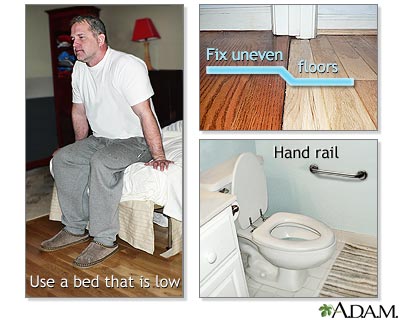
Have a bed that is low, so that your feet touch the floor when you sit on the edge of the bed.
Keep tripping hazards out of your home by:
- Removing loose wires or cords from areas you walk through to get from one room to another.
- Removing loose throw rugs.
- Fixing any uneven flooring in doorways.
Have good lighting, especially for the path from the bedroom to the bathroom and in the bathroom and any stairs.
- Putting hand rails in the bathtub or shower and next to the toilet.
- Placing a slip-proof mat in the bathtub or shower.
Reorganize the home so things are easier to reach. Keep a cordless or cell phone with you so you have it when you need to make or receive calls.
Set up your home so that you do not have to climb steps by:
- Putting your bed or bedroom on the first floor.
- Having a bathroom or a portable commode on the same floor where you spend most of your day.
If you do not have a caregiver, ask your health care provider about having someone come to your home to check for safety problems.
Home Care
Weak muscles that make it more difficult to stand up or keep your balance are a common cause of falls. Balance problems can also cause falls.
When you walk, avoid sudden movements or changes in position. Wear shoes with low heels that fit well. Rubber soles can help keep you from slipping. Stay away from water or ice on sidewalks.
Do not stand on step ladders or chairs to reach things.
Ask your provider about medicines you may be taking that can make you dizzy. Your provider may be able to make some medicine changes that could reduce falls.
Ask your provider about a cane or walker. If you use a walker, attach a small basket to it to keep your phone and other important items in it. A walker with an inbuilt seat will allow you to sit and rest while walking if you need to.
Exercise to Help Build Your Strength
When you stand up from a sitting position, go slowly. Hold on to something stable. If you are having problems getting up, ask your provider about seeing a physical therapist. The therapist can show you how to build your strength and balance to make getting up and walking easier.
When to Call the Doctor
Contact your provider if you have fallen, or if you almost fall. Also contact your provider if your eyesight has worsened. Improving your vision will help reduce falls.
Related Information
Large bowel resectionSmall bowel resection
Heart bypass surgery
Lung surgery
Cataract removal
Bunion removal
Clubfoot repair
Spinal fusion
Knee joint replacement
Hip joint replacement
Transurethral resection of the prostate
Kidney removal
Corneal transplant
Heart bypass surgery - minimally invasive
Gastric bypass surgery
Ankle replacement
Radical prostatectomy
Leg or foot amputation
Total proctocolectomy with ileostomy
Osteoporosis
Stroke
Dementia
Alzheimer disease
Foot amputation - discharge
Leg amputation - discharge
Leg or foot amputation - dressing change
Bathroom safety for adults
Dementia - daily care
Dementia - keeping safe in the home
Phantom limb pain
Multiple sclerosis - discharge
Stroke - discharge
Bathroom safety - children
Diabetes eye care
Ankle replacement - discharge
Dementia - what to ask your doctor
Lung surgery - discharge
Kidney removal - discharge
References
Centers for Disease Control and Prevention website. About older adult fall prevention. www.cdc.gov/falls/about/index.html. Updated January 27, 2026. Accessed April 21, 2026.
Studenski S, Swearingen JV. Falls. In: Fillit HM, Rockwood K, Young J, eds. Brocklehurst's Textbook of Geriatric Medicine and Gerontology. 8th ed. Philadelphia, PA: Elsevier; 2017:chap 103.
US Preventive Services Task Force, Nicholson WK, Silverstein M, et al. Interventions to prevent falls in community-dwelling older adults: US Preventive Services Task Force Recommendation Statement. JAMA. 2024;332(1):51-57. PMID: 38833246 pubmed.ncbi.nlm.nih.gov/38833246/.
Walston JD. Common clinical sequelae of aging. In: Goldman L, Cooney KA, eds. Goldman-Cecil Medicine. 27th ed. Philadelphia, PA: Elsevier; 2024:chap 24.
BACK TO TOPReview Date: 4/9/2026
Reviewed By: Frank D. Brodkey, MD, FCCM, Associate Professor, Section of Pulmonary and Critical Care Medicine, University of Wisconsin School of Medicine and Public Health, Madison, WI. Also reviewed by David C. Dugdale, MD, Medical Director, Brenda Conaway, Editorial Director, and the A.D.A.M. Editorial team.
 | A.D.A.M., Inc. is accredited by URAC, for Health Content Provider (www.urac.org). URAC's accreditation program is an independent audit to verify that A.D.A.M. follows rigorous standards of quality and accountability. A.D.A.M. is among the first to achieve this important distinction for online health information and services. Learn more about A.D.A.M.'s editorial policy, editorial process and privacy policy. A.D.A.M. is also a founding member of Hi-Ethics. This site complies with the HONcode standard for trustworthy health information: verify here. |
The information provided herein should not be used during any medical emergency or for the diagnosis or treatment of any medical condition. A licensed medical professional should be consulted for diagnosis and treatment of any and all medical conditions. Links to other sites are provided for information only -- they do not constitute endorsements of those other sites. No warranty of any kind, either expressed or implied, is made as to the accuracy, reliability, timeliness, or correctness of any translations made by a third-party service of the information provided herein into any other language.
© 1997-
2026 A.D.A.M., a business unit of Ebix, Inc. Any duplication or distribution of the information contained herein is strictly prohibited.
All content on this site including text, images, graphics, audio, video, data, metadata, and compilations is protected by copyright and other intellectual property laws. You may view the content for personal, noncommercial use. Any other use requires prior written consent from Ebix. You may not copy, reproduce, distribute, transmit, display, publish, reverse-engineer, adapt, modify, store beyond ordinary browser caching, index, mine, scrape, or create derivative works from this content. You may not use automated tools to access or extract content, including to create embeddings, vectors, datasets, or indexes for retrieval systems. Use of any content for training, fine-tuning, calibrating, testing, evaluating, or improving AI systems of any kind is prohibited without express written consent. This includes large language models, machine learning models, neural networks, generative systems, retrieval-augmented systems, and any software that ingests content to produce outputs. Any unauthorized use of the content including AI-related use is a violation of our rights and may result in legal action, damages, and statutory penalties to the fullest extent permitted by law. Ebix reserves the right to enforce its rights through legal, technological, and contractual measures.
